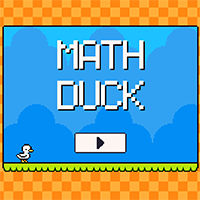
MATH DUCK







SIMILAR GAMES























Description


Math Duck - Unblocked Games at School
About Math Duck - Unblocked Games at School
Math Duck provides an engaging collection of educational games designed specifically for school environments where traditional gaming sites are often restricted. The platform blends puzzle solving, strategy, and interactive challenges that reinforce mathematical concepts while keeping students motivated during short breaks or classroom activities.
Each game on Math Duck is curated to align with curriculum standards, ensuring that learning objectives are met without compromising the fun factor. Teachers can easily find titles that support topics such as arithmetic, geometry, algebra, and data analysis, making the site a valuable supplement to daily lessons.
Key Benefits of Using Math Duck in Educational Settings
The advantages of incorporating Math Duck into school routines extend beyond simple entertainment. Below are some of the most impactful benefits:
- Enhanced Engagement: Interactive gameplay captures attention and fosters a positive attitude toward mathematics.
- Immediate Feedback: Students receive instant responses that clarify misconceptions and reinforce correct solutions.
- Skill Reinforcement: Repetitive practice helps solidify foundational concepts and promotes long‑term retention.
- Collaborative Opportunities: Many games support multiplayer or team‑based modes, encouraging cooperation among peers.
- Safe Environment: All content is vetted for age‑appropriateness and free from inappropriate material.
How to Access Math Duck from School Networks
Accessing Math Duck on school computers is straightforward, provided the network permits external gaming sites. Follow these steps to ensure a smooth experience:
- Navigate to the Official Site: Enter the URL https://ubgatschool.gitlab.io/ into the browser's address bar.
- Verify Network Settings: If the site is blocked, consult the IT administrator to whitelist the domain.
- Select a Game Category: Browse the menu to locate games that match the current lesson plan.
- Launch the Game: Click the desired title and follow on‑screen instructions to begin play.
For classrooms with limited internet bandwidth, teachers can preload selected games during preparation periods to avoid interruptions during instruction.
Popular Game Categories on Math Duck
Math Duck organizes its library into several distinct categories, each targeting specific learning outcomes. The following list highlights the most frequently used sections:
- Arithmetic Challenges: Quick‑fire addition, subtraction, multiplication, and division drills.
- Geometry Puzzles: Shape recognition, angle measurement, and spatial reasoning tasks.
- Algebraic Adventures: Equation solving, variable manipulation, and pattern identification.
- Data & Probability: Graph interpretation, statistical analysis, and chance calculations.
- Math Strategy Games: Tower defense, resource management, and logic‑based scenarios.
Sample Game Walkthrough: Fraction Frenzy
Fraction Frenzy challenges students to match visual fraction models with their numeric equivalents. The gameplay proceeds as follows:
- Identify the shaded portion of a divided shape.
- Select the corresponding fraction from a list of options.
- Receive immediate feedback indicating correctness.
- Earn points for accurate responses, unlocking bonus levels.
This structured approach reinforces conceptual understanding while maintaining a competitive spirit.
Integrating Math Duck Games into Lesson Plans
Educators can design lesson plans that seamlessly blend Math Duck activities with traditional instruction. Effective integration strategies include:
- Warm‑up Sessions: Begin class with a short, timed game to activate prior knowledge.
- Station Rotations: Allocate small groups to rotate through game stations, each focusing on a different skill set.
- Assessment Tools: Use game performance data to identify students who may need additional support.
- Project Extensions: Assign follow‑up worksheets that build on concepts explored during gameplay.
Teacher Tips for Maximizing Learning Outcomes
To derive the greatest educational value from Math Duck, consider the following recommendations:
- Set clear learning goals before selecting a game.
- Limit playtime to maintain focus and prevent fatigue.
- Facilitate debrief discussions to connect game experiences with curriculum content.
- Encourage collaborative problem solving by pairing students with complementary skill levels.
- Monitor progress regularly and adjust game selection based on evolving classroom needs.
Measuring the Impact of Math Duck on Student Achievement
Schools that have implemented Math Duck report measurable improvements in standardized test scores and classroom assessment results. Key indicators of success include:
- Increased accuracy on post‑game quizzes.
- Higher engagement metrics, such as longer active participation periods.
- Improved confidence levels, reflected in student surveys.
- Reduced time required to master core mathematical concepts.
These outcomes underscore the platform’s role as a supplemental instructional resource that enhances traditional teaching methods.
Frequently Asked Questions about Math Duck
Below are common inquiries from educators and administrators:
- Is Math Duck free to use? Yes, all games are accessible at no cost to schools and students.
- Can games be customized for specific grade levels? Many titles allow difficulty adjustments to match grade‑appropriate standards.
- Are there privacy concerns with student data? The platform adheres to strict data protection policies, ensuring that user information remains confidential.
- Do games support multi‑language options? Currently, the majority of content is presented in English, with plans for future localization.
- How can administrators monitor usage statistics? The site provides a dashboard that tracks session counts, popular games, and performance trends.
Conclusion
Math Duck represents a compelling blend of entertainment and education, offering schools a safe, accessible, and curriculum‑aligned gaming experience. By thoughtfully integrating its diverse game library into daily instruction, educators can boost student engagement, reinforce mathematical proficiency, and foster a love of learning that extends beyond the classroom walls.
Play Math Duck for free on Unblocked Games at School,
Discover a platform packed with thousands of top-tier games, completely ad-free and simple to enjoy from any location. Get ready for endless fun with our unblocked games—play using your keyboard or just a click!
How to Play Unblocked Games on ubgatschool.gitlab.io
Steps to Play
Playing unblocked games on ubgatschool.gitlab.io is straightforward and designed for quick access, especially in environments like schools where gaming sites might be restricted. Follow these steps to get started:
- Access the Website: Open a web browser (Chrome, Firefox, or Edge work well) and navigate to ubgatschool.gitlab.io. The site is optimized for instant play, so no downloads or installations are needed.
- Browse the Game Library: Once on the homepage, you’ll see a collection of games across various genres like action, adventure, puzzle, sports, or strategy. Scroll through or use any available search or category filters to find a game that interests you.
- Select a Game: Click on a game’s icon or title. The site is designed to load games directly in your browser, often in fullscreen mode for an immersive experience.
- Start Playing: Most games launch immediately without additional setup. Some may have a brief loading screen. If a game offers customizable settings (like graphics or sound), adjust them before starting for the best experience.
- Bypass Restrictions (if needed): If the site is blocked on a school network, try accessing it via a different device or network. Some users report success by using .io or GitLab links, as these are less likely to be flagged by filters.
- Enjoy Ad-Free Gaming: The platform aims to provide an uninterrupted experience, so you can focus on gameplay without pop-ups or ads.
Game Controls
Controls vary by game genre, but below are common setups for popular types of games you’re likely to find on ubgatschool.gitlab.io. Check individual game instructions for specific details, as some titles may use unique configurations.
Action/Platformer Games (e.g., Stickman games, Retro Bowl)
- Arrow Keys or WASD: Move character left, right, up, or jump.
- Spacebar: Attack, shoot, or perform special actions.
- Shift: Sprint or dodge (in some games).
- Mouse Click: Aim or interact with objects (if applicable).
Puzzle/Strategy Games (e.g., 2048, Geometry Dash)
- Arrow Keys: Navigate tiles, pieces, or menus.
- Mouse Click/Drag: Select or move items (common in match-3 or building games).
- Spacebar: Pause or confirm selections.
- Enter: Start or restart the game.
Sports/Racing Games (e.g., Slope Game)
- Arrow Keys or WASD: Steer vehicle or control player movement.
- Spacebar: Accelerate or jump.
- Shift: Brake or boost (in racing titles).
- Mouse: Adjust camera angle or aim (in some sports games).
Multiplayer/Arcade Games (e.g., Slither.io)
- Mouse: Guide character or cursor (especially in .io-style games).
- Left Click: Boost speed or activate abilities.
- Arrow Keys: Alternative movement controls in some titles.
- Spacebar: Pause or trigger special moves.
Tips for Smooth Gameplay
- Check Game Instructions: Many games include a tutorial or control guide on the start screen.
- Adjust Settings: If a game feels laggy, lower graphics settings (if available) to match your device’s capabilities.
- Stay Responsive: Some games, especially action titles, rely on quick reactions, so ensure your keyboard or mouse is functioning well.
- Bookmark the Site: Save ubgatschool.gitlab.io for easy access during breaks.
This setup should help you dive into gaming on ubgatschool.gitlab.io with ease. If you add specific games or control schemes later, consider including a “Controls” section on each game’s page for clarity. Enjoy gaming!
How to Play Unblocked Games on ubgatschool.gitlab.io
Steps to Play
Playing unblocked games on ubgatschool.gitlab.io is straightforward and designed for quick access, especially in environments like schools where gaming sites might be restricted. Follow these steps to get started:
- Access the Website: Open a web browser (Chrome, Firefox, or Edge work well) and navigate to ubgatschool.gitlab.io. The site is optimized for instant play, so no downloads or installations are needed.
- Browse the Game Library: Once on the homepage, you’ll see a collection of games across various genres like action, adventure, puzzle, sports, or strategy. Scroll through or use any available search or category filters to find a game that interests you.
- Select a Game: Click on a game’s icon or title. The site is designed to load games directly in your browser, often in fullscreen mode for an immersive experience.
- Start Playing: Most games launch immediately without additional setup. Some may have a brief loading screen. If a game offers customizable settings (like graphics or sound), adjust them before starting for the best experience.
- Bypass Restrictions (if needed): If the site is blocked on a school network, try accessing it via a different device or network. Some users report success by using .io or GitLab links, as these are less likely to be flagged by filters.
- Enjoy Ad-Free Gaming: The platform aims to provide an uninterrupted experience, so you can focus on gameplay without pop-ups or ads.
Game Controls
Controls vary by game genre, but below are common setups for popular types of games you’re likely to find on ubgatschool.gitlab.io. Check individual game instructions for specific details, as some titles may use unique configurations.
Action/Platformer Games (e.g., Stickman games, Retro Bowl)
- Arrow Keys or WASD: Move character left, right, up, or jump.
- Spacebar: Attack, shoot, or perform special actions.
- Shift: Sprint or dodge (in some games).
- Mouse Click: Aim or interact with objects (if applicable).
Puzzle/Strategy Games (e.g., 2048, Geometry Dash)
- Arrow Keys: Navigate tiles, pieces, or menus.
- Mouse Click/Drag: Select or move items (common in match-3 or building games).
- Spacebar: Pause or confirm selections.
- Enter: Start or restart the game.
Sports/Racing Games (e.g., Slope Game)
- Arrow Keys or WASD: Steer vehicle or control player movement.
- Spacebar: Accelerate or jump.
- Shift: Brake or boost (in racing titles).
- Mouse: Adjust camera angle or aim (in some sports games).
Multiplayer/Arcade Games (e.g., Slither.io)
- Mouse: Guide character or cursor (especially in .io-style games).
- Left Click: Boost speed or activate abilities.
- Arrow Keys: Alternative movement controls in some titles.
- Spacebar: Pause or trigger special moves.
Tips for Smooth Gameplay
- Check Game Instructions: Many games include a tutorial or control guide on the start screen.
- Adjust Settings: If a game feels laggy, lower graphics settings (if available) to match your device’s capabilities.
- Stay Responsive: Some games, especially action titles, rely on quick reactions, so ensure your keyboard or mouse is functioning well.
- Bookmark the Site: Save ubgatschool.gitlab.io for easy access during breaks.
This setup should help you dive into gaming on ubgatschool.gitlab.io with ease. If you add specific games or control schemes later, consider including a “Controls” section on each game’s page for clarity. Enjoy gaming!